
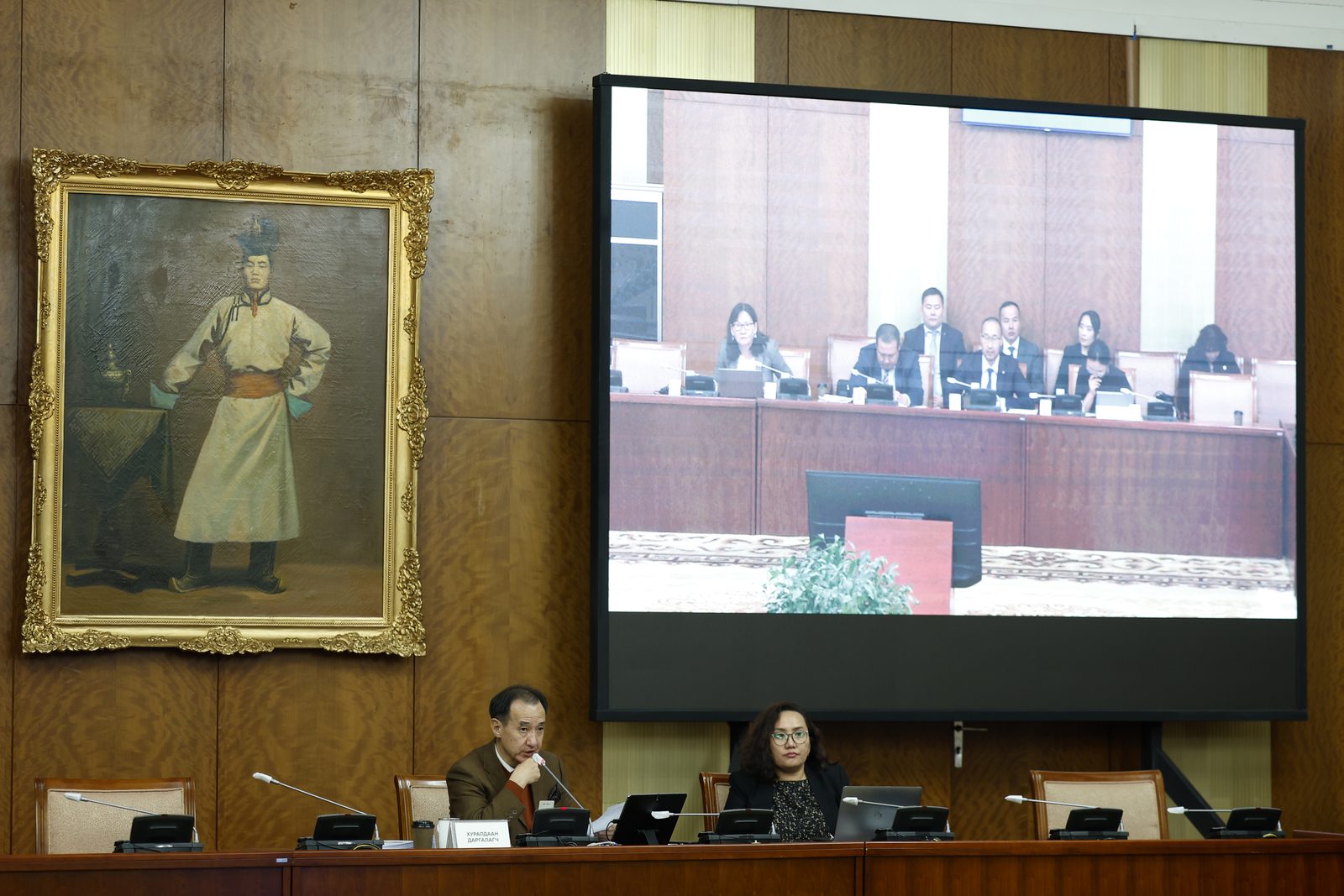
The Standing Committee on Legal Affairs heard the information of the National Human Rights Commission at its meeting on November 21, 2023, as directed by the Speaker of the State Great Hural during the general session of the State Great Hural on Friday, November 17, 2023.
As soon as the commission received information about the incident of the death of a soldier in the Armed Forces Unit No… on the 13th of this month, a working group of the National Human Rights Commission received and clarified information from the relevant officials, and because the personnel of the police were inspecting the crime scene, it was not possible to work in the unit on the day of the incident. But the next day, on November 14, Khunan Jargalsaikhan, Chief Commissioner of the NHRCM, presented that the working group visited the unit of the Armed Forces.
The working group addressed the condition of soldiers serving in the unit at the time of enlisting, as well as evaluated and inquired about information connected to medical examinations and services provided by the unit's personnel.
In connection with the situation, all the soldiers of the unit were to be subjected to a medical examination on the same day, and it was mentioned during the presentation that they were unable to get acquainted with the medical records and relevant documents at that time because the leaders of the military unit took the medical records and related documents with them.
In addition, it was also noted that the camera footage and equipment were taken away for investigation by the police.
During the inquiry, the Commission's working group conducted individual interviews with all conscripts serving in the unit for two days.
Khunan Jargalsaikhan, Chief Commissioner, also informed that they conducted an inquiry into conscripts' barracks, a hospital, a sports center, a kitchen, and sanitary facilities, and made a preliminary conclusion that the soldiers of the Armed Forces Unit were serving under unqualified conditions.
During one-on-one interviews, conscripts repeatedly commented on the fact that they bathed only once a week, were unable to maintain good hygiene, and had poor food quality. He said that it was mentioned that there are many cases of missing personal belongings of conscripts due to poor monitoring of cameras.
Also during the inquiry, the conscripts were most likely to have colds, coughs, and pneumonia, but they provided health services with only a small number of medicines, according to the report.
At the same time, it was mentioned that many conscripts expressed their concern about tuition fees due to the recruitment of students into the army and said that this is an issue that needs to be taken care of.
At the end of his report, he said that because the law enforcement agencies are conducting related actions, the final inquiry report has not been issued.
The National Human Rights Commission has opened and operated a special hotline, 92050222, to receive complaints and information about violations of the rights and interests of conscripts. Enkhbold Batzeveg, Commissioner of the National Human Rights Commission, said that information and complaints of conscripts will be received through this hotline within the last five years, and four complaints have been received.
Two of them were conscript complaints. In the same year, a basic survey involving about 1,500 personnel from 16 armed forces units and organizations was conducted, as did a sample survey on 126 criminal cases. This study was presented in the 21st Report on the State of Human Rights and Freedoms in Mongolia, according to which the State Great Hural approved the relevant resolution and gave instructions to the government and relevant institutions.
The National Human Rights Commission worked in seven units of the Armed Forces to monitor the implementation of the resolution of the State Great Hural, and in that resolution, "The reasons and conditions for the loss of human life and health in the military service, the prevention of crimes and violations, the detection and registration of irregular relations in the military, have been instructed to take preventive measures and monitor the implementation", but the implementation was insufficient.
For example, he pointed out that the risk of accidents, deaths, misfortunes, and loss of life will not decrease if conscripts continue to perform household and background work and services.
In addition, it also emphasized the need to provide compensation, help, and support to citizens who have suffered health and emotional damage during their military service, noted that the National Human Rights Commission presented three reports on the condition of conscripts to the State Parliament and took appropriate measures in each case.
The National Human Rights Commission has conducted an inquiry on the implementation of Resolution No. 49 of 2022 "On Some Measures to be Taken in Connection with the Discussion of the 21st Report on the Status of Human Rights and Freedoms in Mongolia" of 2022 and has sent recommendations to the relevant departments. In addition, detailed information and explanations were given on the requirement of sufficient distribution of the budget of the armed forces and defense sector according to their requests and proposals.
The research conducted by the National Human Rights Commission in 2021 worked on 126 cases individually, and 15 of them were cases where people lost their lives while serving in the military. Four cases were decided by the court. Specifically, Commissioner Enkhbold Batzeveg gave the information that one case was dismissed and four people were charged with criminal responsibility in three cases. Also, 67 out of 126 cases were decided in court. 44.5 percent of them were dismissed because it was a suicide or an unfortunate incident.
At the Standing Committee meeting, Khunan Jargalsaikhan, Chief Commissioner emphasized that the 21st Report on the State of Human Rights and Freedoms in Mongolia concluded that the military unit and organization had an insufficient crime and violation prevention system, non-optimal communication methods with conscripts, and inadequate living and accommodation conditions.